
Travel notes: notebooks and panels
Journeys that shaped a unique body of work
T R A V E L S
See more
The defining feature of Enric Alfons’s work as a painter is, without a doubt, the art that emerged from his singular form of travel: immersing himself in cultures different from his own, with genuine engagement and a deep commitment that made itself felt in every brushstroke, with a gaze far removed from the conventional Eurocentric notion of the “exotic Other.”
This trajectory also broke with another convention, something not unfamiliar to him since his early youth. A special sensitivity to the beauty of his incomparable childhood surroundings in his native Cullera perhaps aroused in him a desire to search further afield for expression, driven by an unquenchable curiosity that compelled him to break through narrow confines, borders and limits. This gave him the strength he needed to challenge taboos, to cast off early ties and leave behind the world, then still predominantly agricultural and fishing-based, to which he had initially seemed destined.
And so, overcoming all kinds of hurdles, he pursued further education in the Fine Arts, which he combined with artistic creation throughout the 1970s, holding solo exhibitions and successfully applying for awards, grants and scholarships to continue his studies. In the early 1980s, after graduating, he began his teaching career.
Previously divided into two strands, one geared toward the market to secure a living, and another politically motivated and tied to his leftist activism, his work entered a period of crisis. This was driven by personal and intellectual motivations, as well as disillusionment with the social and political context and the art market, both locally in Valencia and more broadly across the Global North.
When he spoke about the path he set out on at this moment in time, it is telling that he described it as a “flight” to the South and a search for authenticity.
After his first trip to Morocco, he realized the strength of his attraction and passion for the South, with such close affinity that it almost felt like a desire for identification: “It was if I had discovered the first agrarian cultures... I will never forget the warmth of the welcome I received in villages.” Wearing a djellaba, he blended in discreetly into village life, sketching or painting with a notebook or one of his signature small wood panels.
This temperament also defined many aspects of his life, ranging from his austere personal habits to his academic work, evinced by his choice of art brut as the subject of his doctoral dissertation,[1] the doctoral course he taught in 1989 on "Marginal Expressions" as well as the supervision of various theses on naïf painters.
Now that his new employment situation freed him from the pressure of meeting the demands of the market, he gave free rein to raw creativity in his painting. At first, this took the form of a powerful primitivism, expressed through formal themes that married well with this aesthetic: fetitxes, masks and the malhafa.[2] This primitivism would continue, albeit in different forms, in his later phases.
As the relationships and indeed friendships he established with local communities evolved, he took on a commitment for his painting to reflect, describe and narrate their everyday realities, both in festive moments and in more dramatic events: a siesta in a Mauritanian village, the bustling atmosphere of a market in Larache, African immigrants resting on a Sunday in a park in Paris, the harrowing journey across the Strait of Gibraltar in a small boat, the equally painful exodus of Albanians in the 1990s, or the day-to-day scenes in humble harira soup kitchens in Morocco.
Over a span of twenty years, starting out in the 1980s, he travelled extensively and as frequently as his teaching duties allowed: Morocco, Tunisia, Mauritania, Algeria, Turkey, Kurdistan, Paris and London, Albania, North Macedonia, Syria and Jordan.
Painting was his life, and he lived and travelled in order to paint. Even when, in the early 2000s, his new family situation brought a halt to these art-driven journeys, his mind and spirit remained linked to those worlds through the memories he had accumulated, as one can readily discern in his work from that period.
In his fifties, life led Alfons on a journey of another kind, this time an inner journey. His paintings, notebooks and small wood panels (an element from his earlier travels he maintained) give us an insight into the artist’s emotions and feelings, largely aroused by events in his own personal environs but also by the social and political events of the time, and by the memories of his past travels as well as the occasional visit to his beloved Morocco, which he looked on as a form of recharging his batteries.
His friend, the writer Ferrán Cremades i Arlandis, was a travel companion on some of those early journeys and penned some texts for one of Alfons’s seminal exhibitions, Deessa Màscara, held at the Caixa de Pensions exhibition centre in Valencia in July 1984.
In his homage text Itinerario sin fin (Autumn 2017),[3] Cremades wrote a lyrical ode to the artist’s travelling life. For instance, we have this particularly incisive line: “One of his challenges was to break the rigidity of established languages and the unbreachable boundaries that distanced him from the search for the Other.”
In August 2018, his hometown of Cullera hosted the posthumous exhibition Viajar, conocer, pintar, organised by the local town council. The chosen theme of travel, as reflected in the title itself, was considered the most fitting tribute to a figure often described as the travelling painter.
The exhibition catalogue published for the occasion included texts by the curator and art historian Boye Llorens Peters, the art critic Román de la Calle and the writer Abelardo Muñoz.[4]
Boye Llorens remarked how Enric Alfons’s little wooden panels brought to mind the boards used by the painter Ignacio Pinazo. He went on to underscore how both artists made painting their life’s motivation and allowed it to guide their path. For Alfons, travel was a principal motif, though, as Llorens points out, his driving motivation was always painting itself: “Alfons’s commitment and determination to know and learn from neighbouring Mediterranean cultures is a journey initially driven by the pure need to paint and but he soon discovered that this need to paint also brings with it an intrinsic need to learn through painting.”
Román de la Calle’s input to the exhibition and the catalogue is particularly meaningful because, as an exhibition curator and art critic, he had followed Alfons’s trajectory for a long time and was a close observer of the artist’s evolution since the early 1980s. His profound knowledge of Alfons’s work enabled the critic to offer valuable insights into the artist’s practice.
De la Calle had sat on the jury of the inaugural edition of Alfons Roig Prizes and Grants in 1981, which was when he first met Alfons, who was eventually awarded one of the grants. “The project that found funding thanks to the scholarship […] was able to respond to a feeling until then contained and determinedly set out on a flight to the South […] an attractive mission of discovery and liberation, ideal to be adopted and shared […]by a dreamer of different worlds, who defended his own personal universe, precisely in this kind of emancipatory journeys.”
Meanwhile, Abelardo Muñoz, who afforded an additional viewpoint insofar as he shared with Alfons a number of significant points of connection, such as their shared travelling spirit, including periods spent in Morocco[5] and their meetings in Valencia and in Morocco itself, offered a beautiful reflection on the artist’s perspective, both during his travels and in the way he later conveyed them in his work: “There is no Western gaze in Alfons, just a radical commingling with the environment and an engagement with its people. He is also a painter with inklings of an anthropologist and a social chronicler; someone who looks where nobody else looks.”
NOTEBOOKS AND PANELS
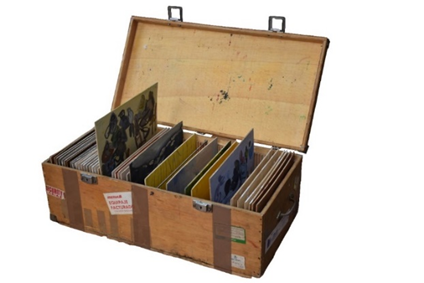
As well as his camera, on Enric Alfons’s travels along different paths and through different geographical regions, at first he took with him sketch pads and notebooks and then, later, from the 1990s onwards, a small trunk with little wood panels that allowed him to capture events and sensations in the moment they occurred. The panels also enabled him to record the atmosphere and colour of the scenes before him.
He carried these small panels, measuring roughly 20 x 30 cm, in trunks whose size varied depending on the the length of the particular trip. Without his own vehicle, it is still a cause of wonder to many people how he managed to take these trunks in overcrowded taxis or local buses, sometimes clocking up thousands of kilometres.
For Boye Llorens, when he introduced the process of working with these small wood panels Alfons began to forge a strong personal identity as a painter. What interested him, Llorens tells us, was capturing the visual effects of the contrasts of colour and light that outline the figures and forms, rendered with various techniques of applying paint. The use of wood panels enabled him to sculpt forms and to structure compositions through colour, achieving a sense of immediacy and authenticity by mixing and applying oil paint on the spot. According to Llorens, these panels are “of such significance for a proper understanding of the artist’s concerns that they can ultimately be seen as works in their own right, transcending the quality of a pure sketch.”
Even when Alfons embarked on his aforementioned inner journey, he never abandoned the panels. Instead, they accrued, again in Llorens’s words, “a stylistic refinement which is more sophisticated and, above all else, more attuned to self-reflective thinking.”
This section includes a few examples of his notebooks not only for their intrinsic beauty but also as a record of the early phases of his practice. But the real spotlight is given to his fondly-treasured panels, the markers left along the path by the pintor viatger, the traveling painter, and, as Román de la Calle put it, “turned into personal traces, even until the final vital journey of his life."
[1] PhD dissertation “Sobre el Art Brut: las creaciones de Pepe de Valencia,” 1987, supervised by Juan Ángel Blasco Carrascosa, with cum laude honours.
[2] Malhafa is a type of brightly patterned veil that covers the body and head of women from the Sahara region.
[3] Complete text available on Cremades’s webpage https://ferrancremades.es/index.php/art__cultura/enric-alfons/
[4] Viajar, conocer pintar, Town Council of Cullera, 2018. Catalogue includes texts by Boye Llorens Peters: Viajar, conocer, pintar; Román de la Calle: Recordando la trayectoria artística de Enric Alfons. Notes on de road; Abelardo Muñoz: Los baúles de Enric.
[5] In his book Exilio Atlántico (Ediciones Canibaal, 2018), he recounts, in the form of travel notes, his journeys and stays in Morocco, especially the one that took place over several months in the 1990s, in Larache, Jemis Sahel and Tangier.
This trajectory also broke with another convention, something not unfamiliar to him since his early youth. A special sensitivity to the beauty of his incomparable childhood surroundings in his native Cullera perhaps aroused in him a desire to search further afield for expression, driven by an unquenchable curiosity that compelled him to break through narrow confines, borders and limits. This gave him the strength he needed to challenge taboos, to cast off early ties and leave behind the world, then still predominantly agricultural and fishing-based, to which he had initially seemed destined.
And so, overcoming all kinds of hurdles, he pursued further education in the Fine Arts, which he combined with artistic creation throughout the 1970s, holding solo exhibitions and successfully applying for awards, grants and scholarships to continue his studies. In the early 1980s, after graduating, he began his teaching career.
Previously divided into two strands, one geared toward the market to secure a living, and another politically motivated and tied to his leftist activism, his work entered a period of crisis. This was driven by personal and intellectual motivations, as well as disillusionment with the social and political context and the art market, both locally in Valencia and more broadly across the Global North.
When he spoke about the path he set out on at this moment in time, it is telling that he described it as a “flight” to the South and a search for authenticity.
After his first trip to Morocco, he realized the strength of his attraction and passion for the South, with such close affinity that it almost felt like a desire for identification: “It was if I had discovered the first agrarian cultures... I will never forget the warmth of the welcome I received in villages.” Wearing a djellaba, he blended in discreetly into village life, sketching or painting with a notebook or one of his signature small wood panels.
This temperament also defined many aspects of his life, ranging from his austere personal habits to his academic work, evinced by his choice of art brut as the subject of his doctoral dissertation,[1] the doctoral course he taught in 1989 on "Marginal Expressions" as well as the supervision of various theses on naïf painters.
Now that his new employment situation freed him from the pressure of meeting the demands of the market, he gave free rein to raw creativity in his painting. At first, this took the form of a powerful primitivism, expressed through formal themes that married well with this aesthetic: fetitxes, masks and the malhafa.[2] This primitivism would continue, albeit in different forms, in his later phases.
As the relationships and indeed friendships he established with local communities evolved, he took on a commitment for his painting to reflect, describe and narrate their everyday realities, both in festive moments and in more dramatic events: a siesta in a Mauritanian village, the bustling atmosphere of a market in Larache, African immigrants resting on a Sunday in a park in Paris, the harrowing journey across the Strait of Gibraltar in a small boat, the equally painful exodus of Albanians in the 1990s, or the day-to-day scenes in humble harira soup kitchens in Morocco.
Over a span of twenty years, starting out in the 1980s, he travelled extensively and as frequently as his teaching duties allowed: Morocco, Tunisia, Mauritania, Algeria, Turkey, Kurdistan, Paris and London, Albania, North Macedonia, Syria and Jordan.
Painting was his life, and he lived and travelled in order to paint. Even when, in the early 2000s, his new family situation brought a halt to these art-driven journeys, his mind and spirit remained linked to those worlds through the memories he had accumulated, as one can readily discern in his work from that period.
In his fifties, life led Alfons on a journey of another kind, this time an inner journey. His paintings, notebooks and small wood panels (an element from his earlier travels he maintained) give us an insight into the artist’s emotions and feelings, largely aroused by events in his own personal environs but also by the social and political events of the time, and by the memories of his past travels as well as the occasional visit to his beloved Morocco, which he looked on as a form of recharging his batteries.
His friend, the writer Ferrán Cremades i Arlandis, was a travel companion on some of those early journeys and penned some texts for one of Alfons’s seminal exhibitions, Deessa Màscara, held at the Caixa de Pensions exhibition centre in Valencia in July 1984.
In his homage text Itinerario sin fin (Autumn 2017),[3] Cremades wrote a lyrical ode to the artist’s travelling life. For instance, we have this particularly incisive line: “One of his challenges was to break the rigidity of established languages and the unbreachable boundaries that distanced him from the search for the Other.”
In August 2018, his hometown of Cullera hosted the posthumous exhibition Viajar, conocer, pintar, organised by the local town council. The chosen theme of travel, as reflected in the title itself, was considered the most fitting tribute to a figure often described as the travelling painter.
The exhibition catalogue published for the occasion included texts by the curator and art historian Boye Llorens Peters, the art critic Román de la Calle and the writer Abelardo Muñoz.[4]
Boye Llorens remarked how Enric Alfons’s little wooden panels brought to mind the boards used by the painter Ignacio Pinazo. He went on to underscore how both artists made painting their life’s motivation and allowed it to guide their path. For Alfons, travel was a principal motif, though, as Llorens points out, his driving motivation was always painting itself: “Alfons’s commitment and determination to know and learn from neighbouring Mediterranean cultures is a journey initially driven by the pure need to paint and but he soon discovered that this need to paint also brings with it an intrinsic need to learn through painting.”
Román de la Calle’s input to the exhibition and the catalogue is particularly meaningful because, as an exhibition curator and art critic, he had followed Alfons’s trajectory for a long time and was a close observer of the artist’s evolution since the early 1980s. His profound knowledge of Alfons’s work enabled the critic to offer valuable insights into the artist’s practice.
De la Calle had sat on the jury of the inaugural edition of Alfons Roig Prizes and Grants in 1981, which was when he first met Alfons, who was eventually awarded one of the grants. “The project that found funding thanks to the scholarship […] was able to respond to a feeling until then contained and determinedly set out on a flight to the South […] an attractive mission of discovery and liberation, ideal to be adopted and shared […]by a dreamer of different worlds, who defended his own personal universe, precisely in this kind of emancipatory journeys.”
Meanwhile, Abelardo Muñoz, who afforded an additional viewpoint insofar as he shared with Alfons a number of significant points of connection, such as their shared travelling spirit, including periods spent in Morocco[5] and their meetings in Valencia and in Morocco itself, offered a beautiful reflection on the artist’s perspective, both during his travels and in the way he later conveyed them in his work: “There is no Western gaze in Alfons, just a radical commingling with the environment and an engagement with its people. He is also a painter with inklings of an anthropologist and a social chronicler; someone who looks where nobody else looks.”
NOTEBOOKS AND PANELS
As well as his camera, on Enric Alfons’s travels along different paths and through different geographical regions, at first he took with him sketch pads and notebooks and then, later, from the 1990s onwards, a small trunk with little wood panels that allowed him to capture events and sensations in the moment they occurred. The panels also enabled him to record the atmosphere and colour of the scenes before him.
He carried these small panels, measuring roughly 20 x 30 cm, in trunks whose size varied depending on the the length of the particular trip. Without his own vehicle, it is still a cause of wonder to many people how he managed to take these trunks in overcrowded taxis or local buses, sometimes clocking up thousands of kilometres.
For Boye Llorens, when he introduced the process of working with these small wood panels Alfons began to forge a strong personal identity as a painter. What interested him, Llorens tells us, was capturing the visual effects of the contrasts of colour and light that outline the figures and forms, rendered with various techniques of applying paint. The use of wood panels enabled him to sculpt forms and to structure compositions through colour, achieving a sense of immediacy and authenticity by mixing and applying oil paint on the spot. According to Llorens, these panels are “of such significance for a proper understanding of the artist’s concerns that they can ultimately be seen as works in their own right, transcending the quality of a pure sketch.”
Even when Alfons embarked on his aforementioned inner journey, he never abandoned the panels. Instead, they accrued, again in Llorens’s words, “a stylistic refinement which is more sophisticated and, above all else, more attuned to self-reflective thinking.”
This section includes a few examples of his notebooks not only for their intrinsic beauty but also as a record of the early phases of his practice. But the real spotlight is given to his fondly-treasured panels, the markers left along the path by the pintor viatger, the traveling painter, and, as Román de la Calle put it, “turned into personal traces, even until the final vital journey of his life."
[1] PhD dissertation “Sobre el Art Brut: las creaciones de Pepe de Valencia,” 1987, supervised by Juan Ángel Blasco Carrascosa, with cum laude honours.
[2] Malhafa is a type of brightly patterned veil that covers the body and head of women from the Sahara region.
[3] Complete text available on Cremades’s webpage https://ferrancremades.es/index.php/art__cultura/enric-alfons/
[4] Viajar, conocer pintar, Town Council of Cullera, 2018. Catalogue includes texts by Boye Llorens Peters: Viajar, conocer, pintar; Román de la Calle: Recordando la trayectoria artística de Enric Alfons. Notes on de road; Abelardo Muñoz: Los baúles de Enric.
[5] In his book Exilio Atlántico (Ediciones Canibaal, 2018), he recounts, in the form of travel notes, his journeys and stays in Morocco, especially the one that took place over several months in the 1990s, in Larache, Jemis Sahel and Tangier.
